Blog Archives
Disk 8
(Before I begin this disk, I invite you to take a gander at an Atari retrospecticus, covering 1977-1981, and a look at Atari 8-bit computing.)
Dig Dug
 Dig Dug was another classic arcade game published by Namco (the Pacman guys) You’re a little white guy named Dig Dug (presumably American; if he were British or Canadian he’d be Dig Doug and his name’d be more normal), and your object is to dig. The dirt you dig will be dug, and you get points for all the dug dirt you dig. In addition, two types of creatures are found in your dirt: little dwarf-looking dudes with scuba goggles on and some sort of dragons wearing vests that breathe fire (duh). Your real object is to rid your poor garden of these pests. One way is to dig underneath a “rock” which looks way more like an eggplant. The rock will fall, and hopefully crush a dwarf or dragon. The other way is a bit more grotesque: you’ve got a little air pump that you can use to inflate a creature until it explodes in a gory fashion. Well, gory for a game made in 1981, anyway. Well, fine, there’s no gore, but it still looks like a horrible way to go. I’d rather have a rock dropped on me!
When you’ve destroyed all the creatures you move on to the next level, where there are more creatures. This may prove to be more difficult that originally predicted, however, as both the dwarf-things and dragons have an ability to suddenly turn into uncrushable, uninflatable ghosts that come straight at you until they touch you and you also turn into a ghost (or at least just lose a life). Since the beasts obviously are going for you when they pull this trick, one may wonder why they don’t just swarm you in their unkillable state, providing no escape for poor D(o)ug. Instead they just (sometimes) turn back into inflatable creatures when they hit a tunnel. One also may wonder how many early video game heros would suffer quick and/or painful deaths if early video game antagonists could do more than move in a line and shoot. Sheesh, it’s like the Daleks! “Oh no! Stairs!”
Anyway, back to the game. Dig Dug is another game in the Namco tradition of “super-simple concept made addicting” and it’s a pretty fun game. The controls are a little quirky, as you can’t turn unless you’re at an exact spot in a tunnel, as you can only make tunnels a certain distance apart. The graphics ain’t too hot on this port, so if you want better graphics go find an arcade version, but this one holds up all right in terms of gameplay.
Side note: apparently Dig Dug (the character) was later referred to as the “Hero of the South Island Incident.” This fires the imagination much more than exploding vest-wearing dragons using an air pump. Or maybe that’s just me.
Rating: C (like Pacman, there are better versions out there)
Pogoman
 Pogoman is a surprising little game, and one of the most influential games I played as a kid. For anyone who’s played this game that may seem surprising, as the game, while fun, is certainly nothing incredibly groundbreaking. You’re a little blue guy on a rolling pogo stick (yeah, I know it doesn’t make sense) rolling through a town at night, although you look more like the international handicapped sign guy without the wheel on the back. Occasionally you have to jump over sewer grates, fire hydrants, and cars. If you hit one you fall down and your pogo stick becomes a neutron star apparently, as it looks like all your limbs get sucked into it until you’re a painful blue blob. There are certain street lights along the route that you can jump up and swipe for extra points, giving this seemingly law-abiding pogo man a dangerous criminal undertone.
At the end of the first level you go back to the start and do it again. You don’t even loop back to the start; you’re just going along and suddenly the grassy-looking park in the background glitches back to the buildings at the beginning. But now, the city’s a bit more populated: there are cats, ducks, and unicyclists (!!) that are now coming at you, and you get neutron-starred if you hit any of them as well (oddly enough, the unicyclists breeze on by as if nothing happened. Those guys have got inner ear control to die for). Starting at the third level, a bird comes screaming out of the sky at your face every few seconds. Presumably the bird can’t see where it’s going to be flying into people’s faces, possibly because, oh, I don’t know, somebody stole all the freakin’ street lights in the city!! Well, you made your bed; now you’ve got to lie in it.
While Pogoman is a pretty fun, simple game in its own right, what made it one of my favorites was the tune that played over and over during the whole game. It seemed…peaceful. That was rare for any video game at the time, what with limited sound hardware trying to bleep and bloop its way into your brain. Playing this game was my childhood equivalent of turning on Enya, going into some sort of yoga pose, and doing those deep breaths that help a person control his or her inner chi or kai or whatever. After a hard day of schoolwork and kids kicking you down hills because you’re two years ahead of them in math and you pick your nose, it was nice to have something to relax to. The music here was one of the pieces that influenced me to become interested in music later in life. In fact, not too many years ago I even did a remix of it that you can find on my Soundclick page (note: the clarinet sound suuuucks!).
In any case, check it out when you’re feeling stressed enough that you just need to relax and think of nothing but jumping over convertibles and unicycles for a while. You’ll be glad you did.
Rating: B+
Race in Space
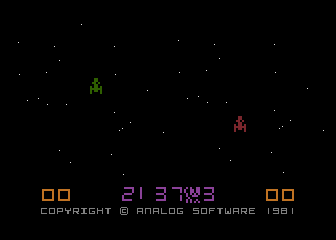 This game is so obscure that my blog pops up fourth in a Google search for “race in space” atari. It’s a fun little multiplayer game in which you race a friend to the top of the screen several times. Every time you hit the top of the screen you get a point. Whoever had the most points at the end of three minutes wins! Normal obstacles include the stars that drift across the screen. They’re not really stars, I assume (unless these are freakin’ huge spaceships), since hitting one sends you sprawling back to the beginning.
The real fun in this game, though, comes from the options to customize the gameplay. You can change what the joystick trigger does: it either has no effect, shoots a missile at the other player (which gets you a point if it hits him), turns on a shield (which makes you immune to the stars, but you can’t move while it’s on), or move at super-fact speed. You can change the density of the stars until there’s almost more star than space onscreen. You can change between rockets (which can only go straight up and down) and saucers (which can move anywhere). You can turn on comets, which are giant glowing balls of static that blow by at varying speeds and take your ship down with them if they make contact. And finally, and most strangely, you can switch between a “positive” and “negative” universe. In the negative universe every few seconds the screen flashes white with a strange sound effect, causing seizures in all the poor epileptic kids playing the game.
Race in Space automatically gets some brownie points for being a competitive multiplayer game rather than a turn-based one, which was a rarity at the time. In addition, it’s pretty fun, and with all the different options you can play the game in dozens of different ways. I recommend it for anyone looking to kill three minutes with a friendly rival. (You may also note that the timer in the screenshot above doesn’t have a colon and a dot, but a line and a weird cat-looking thing. I have no idea why, but I bet the reason would make Johnny Hart’s head explode.)
Rating: B
Fort Apocalypse
 Fort Apocalypse was one of my favorite games growing up, for the main reason that the game was set in a much bigger world than, say, Dig Dug or Centipede. According to Wikipedia, you’re a Rocket Copter pilot flying for the Sky Dwellers, flying into Fort Apocalypse, a dangerous Kralthan prison located deep within the Earth’s mantle. What that translates to is you’re flying a yellow helicopter that shoots and drops bombs in a big system of caverns, with tanks, little floating dudes that move slowly back and forth (see Dig Dug), and a purple helicopter flown by a guy so bent on your destruction that he often flies into walls trying to get to you rather than, you know, flying around obstacles trying to stay alive. Those poor, gullible Kralthans, with their Kralthan ways, deep in the Earth’s mantle, I tell you, boy.
Your job is to fly in these caverns and pick up guys walking around, presumably downed pilots or hostages or something. Your fuel drops steadily, but fortunately, the Kralthans have kindly provided you with two refueling stations (one in each section of the caverns), which is very thoughtful of them. The caves are not only filled with enemies, but Blue Lasers and transporters, and walls that randomly disappear and reappear. After you get to the bottom of the first level (named the Vaults of Draconis), you enter the Crystalline Caverns. This level has four main sections: a tunnel at the top, a cavern filled with lasers and tanks, a cavern filled with shootable walls, and some sort of reactor core that you must blow up. Unfortunately, the game randomly picks which of the two caverns leads to the reactor core, so you can spend fifteen freakin’ minutes shooting through all those walls just to find a dead end. Anyway, once the reactor core blows up all the lasers (and transporters, sadly) stop working and you can easily fly back up to the Vaults of Draconis and fly out. Yay! You’ve saved the nameless people from the random bad guys, and more impressively, you flew a helicopter into and out of the Earth’s mantle! I mean, what the foo?!?
Fort Apocalypse shares some attributes with later-generation games: a larger world for you to explore rather than a repeating screen with progressively faster and harder enemies. Unfortunately, unlike, say, Pitfall II, the world isn’t interesting enough to return to, so after you beat the game once there isn’t much to keep you coming back. Oh sure, there’s a score, but it’s like the score in Super Mario Bros.: nobody really cares unless you’re playing in some sort of tournament or something. Do try it though; it’s fun at least once!
Rating: B+
Gamestar Baseball
 And now, another sports game for you hopeless computer game nerds. Fortunately, this game is a lot easier to figure out than Starbowl Football, mostly because baseball itself is much less complicated than football. I’m not going to explain the rules of the game (it’s frikkin’ baseball), but I will say that it’s pretty easy to control as either team. The sound effects are pretty good for the time, from the crack of the bat to the crowd’s cheering, to the fanfares played between innings and when bases are stolen or loaded. The most entertaining part of the game, however, comes at inning breaks, when it cuts to the Jumbotron screen advertising random things from the scores in that day’s American League games to the day’s attendance to a plug for a waterskiier jumping across the Bermuda Triangle the following week. Goony!
As far as sports simulation on the Atari goes, Gamestar Baseball was a very good, intuitive game, and if you are into old-school sports games I would advise you to put this one near the top of the list.
Rating: B
That does it for Disk 8. Coming up next: the first side of Disk 9, which covers Jumbo Jet Pilot, Eastern Front 1941, Drelbs, Miner 2049er, and Dog Daze. See you then!
Disk 7
Starbowl Football
 What could be more American than an ol’ fashioned game of football? Starbowl Football aims to bring the excitement of the gridiron into your own home! Now you, the armchair quarterback, can choose and execute the plays to lead your team to victory!
Of course, the preceding paragraph describes every football video game ever made. What it doesn’t say, however, is how freakin’ hard this particular one is! Consider this: I grew up with this Atari to play on. Instead of playing sports, I played with the computer. About the only things I knew about football is that a bunch of guys huddle, then hike the ball and run into each other. Eventually, somebody’d get a touchdown. I didn’t know how it happened, just that it did (and if I tried to play it with kids my own age, I’d get laughed at until I cried and hid under those giant tires they used to have in playgrounds). So, coming into this game, I had virtually no knowledge of how it worked.
Now consider that we got all these probably pirated games with no instruction manuals, and you had a recipe for the computer beating me soundly every single time without me knowing what was going on. Now add to this the fact that, even if I had the instruction manual, it had instructions such as this:
“Press and release the RED button on joystick to designate as eligible; otherwise, choose a pass pattern by pushing the joystick in the appropriate direction: square out, screen, fly, or slant in. TR will turn to face defense once programmed. Choose blocking assignments for OL (as a group) by pushing the joystick in the appropriate direction: sweep top, pass protect, trap middle, or sweep bottom. OL will turn to face defense once programmed.”
Heck, I barely understand that now, let alone when I was an eight-year-old computer nerd. Even playing the game now, knowing at least a marginal amount about football (thanks, EA Games!), I still can’t figure out how to execute some basic commands, like, say, passing the football! The quarterback just runs around with his arm raised, no matter what button I press or direction I run, until he passes the line of scrimmage, and if every play I call is a running play, the computer pretty much murders me.
There may be a fun game in Starbowl Football, but I sure as heck couldn’t figure it out. In this day and age there are tons of better football games out there anyway, so stick to something else and pass this one by.
Rating: F
Pole Position
 The premier racing game back in the day, Pole Position puts you in a first-person-view F1 racing car. You pick a track from four options (although one is a practice course and all four have the exact same map, so I don’t really know what the difference is) and how many laps you will complete. Then, you’re off; but first, you complete a qualifying lap, which will determine in what position you begin the race, the pole position, of course, being first. You seem to have filled up your car with nitrous oxide instead of gasoline, however, since your car is at least twice as fast as any other car on the course. If you crash into anything (another car, a road sign, etc.) you will immediately reappear, but since the time ticks over a crash, it becomes more unlikely that you’ll finish the race with each crash. This is preferable to actual car racing, where each crash results in fireballs and thousands of dollars in property damage and hospital bills, so there’s something to be said for that.
Pole Position defined a lot of what makes up the racing car game genre, including checkpoints that increase your time remaining, the first-person view (instead of top-down), and many other innovations. The sound is surprisingly good for the Atari 8-bit era, and the course, while the same each time, is always pretty difficult due to the other cars on the track. Of special note is what I call the Dead Man’s Curve: a really sharp turn about halfway through the course that inevitably results in a crash with a red road sign off to the right of the road, unless you turn early enough, brake, or downshift (that’s right, you’ve gotta shift in this game too, but you only get two gears so it’s not too difficult). All in all, Pole Position isn’t just a pioneer, it’s a great game, and I recommend it for anyone into racing games.
Rating: B+
PitStop
 Another racing game, PitStop has an added gimmick that Pole Position lacked: namely, the fact that racing is hard on a car and it might explode if you’re not careful (and not just by running into other cars or road signs)! The racing part is fairly elementary: you’re on a course, with a map in the corner that you kind of follow (the road gently curves every time there’s a bend on the map, but it’s not exact by any means). You race against some amount of yellow cars, whose main objective is apparently to bump into you like bumper cars (they even make a “bump” noise if you collide with one). Every bump wears down your tires a bit, but if you try to off-road it your tires wear down super-fast. Once the tires wear out too much, KABOOM! Your game’s over.
This is why, every lap, you have a chance to stop in the pit stop area and refit your tires (and fill up your gas, which is also running out). Unfortunately, this is done by a laborious process of selecting a man who slowly walks up to your car, grabs a tire (if you can get the pixel-perfect collision-detection to work), drags it over to a barrel, turns it blue, and drags it back to the car. All of this takes time out of the race. Since you’re just racing against yourself (and the clock) I guess it doesn’t matter, but it is a little annoying.
PitStop is an all right racing game, but it’s a little subpar when compared with games like Pole Position, as the racing part itself isn’t nearly as fun and the pit stop gimmick doesn’t do much for me than be annoying. Give it a shot if you want, but I’ll stick with Mario Kart.
Rating: B-
Speedway Blast
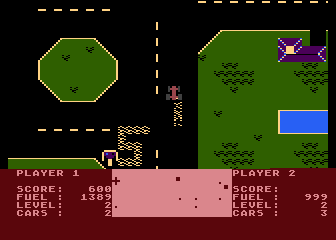 You may think, with the racing motif on this disk, that a game with a name like Speedway Blast would be another along those lines, but that’s not the case. Here you’re some sort of car-driving, um, character, whose job is to pick up eggs left at intersections in an upscale suburban neighborhood somewhere. If you don’t pick up an egg fast enough it ends up hatching into a weird, buck-toothed creature who pees all over the road. At least, that’s sure what it looks like. You then have to shoot all the creatures and their, um, droppings, to advance to the next level, where (boy am I sick of writing this next phrase) the colors change and the enemies move faster. If you run into a monster or its leavings, you blow up. Also, you can drive off-road (in the grass), but if you hit a bush, house, swimming pool, or other landmark of suburbia, you also blow up.
I don’t really know where the “speedway” part comes into it, since you’re driving around some WASP neighborhood shooting monsters (although you can go pretty fast in later levels), but what really baffles me is the premise for the game. I mean, eggs left at intersections that hatch into buck-toothed creatures who pee all over the street? Who comes up with ideas like that for a game? Oh, that’s right. (Careful with that link: the video does contain some profanity.)
Anyway, the game itself is pretty fun, although in later levels it moves at an insane speed. I’d recommend it if you’ve got some time to kill in a weird way.
Rating: C+
Reversi
 Honestly, I’ve got very little to say about this game. It’s an Atari version of Othello. You pick the computer’s difficulty level and whether you go first, although you’re always white. If you like Othello, this version’s a nice vanilla version of it.
That’s about all I got on that.
I like pie.
Rating: D
Super Cobra
 You would think that a video game from Parker Brothers would be more of a Monopoly or Risk-based title, but this is apparently a port of a Konami arcade game. You pilot the Super Cobra helicopter over some pretty unfriendly territory, what with the tanks shooting and rockets being shot at you. In addition, the terrain itself is pretty jagged and often you fly into tight tunnels with little room to maneuver. You’re armed with a gun and little bombs, and each press of the trigger alternates between shooting the gun and dropping a bomb. You’ve also got to keep an eye on your fuel meter, which can be refilled by shooting or bombing fuel containers on the ground. I’m not quite sure how that works, though, but if every time I needed to fill up my car I had to take a hood-mounted rocket launcher and blow up the nearest Chevron—well, let’s just say that I’d do a lot more driving.
In any case, after every two levels a really goofy tune plays and a message appears showing how many miles you’ve gone (1000 miles for each two levels passed). Also, every pair of levels share a common theme. Sometimes it’s just rockets and tanks in narrow caves or in cities, but sometimes you also have to contend with flying aliens or UFOs or, um, whatever is flying across in the screenshot above. (Ping-pong paddles? Happy flying fish?) What’s nice about this game is the unlimited continues: if you run out of lives you can start on the same level you were on, just with your score reset. This way even the most inept game player can still slog through and see the end of this game without too much repetitiveness.
Speaking of the end of the game, the objective is not to save the world from space invaders or save civilians or even blow up the enemy base. No, the very last level requires you to pick up a giant crate with a dollar sign emblazoned on the outside. That’s right, much like the “terrorists” from Die Hard, your real goal isn’t anything altruistic or even political; it’s simple thievery. Unfortunately, John McClane doesn’t end up driving a car over a ramp to collide with your helicopter in a giant fireball, as that would make this game about a thousand times more awesome.
Still, Super Cobra is an excellent game, with a lot of varied, challenging gameplay, colorful graphics, and fun sound and music. Definitely recommended.
Rating: A-
So much for disk 7. Coming up next: Disk 8, featuring Dig Dug, Pogoman, Race in Space, Fort Apocalypse, and Gamestar Baseball. See you then!
Disk 6
EDIT: A video review of these games is available!
Buck Rogers: Planet of Zoom
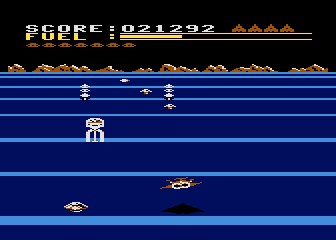 It’s Buck Rogers! And he’s having adventures in the 25th century or whatever! I know pretty much nothing about the early 20th-century phenomenon that is Buck Rogers, so I can’t really compare to see if this game stays faithful to its source material or if it just uses the name in an attempt to get people to buy the game. In any case, you’re in a ship flying over a pseudo-3D planet landscape that consists mostly of scrolling lines and mountains in the background. Your mission: fly through goalposts. No, really, that’s your mission. It’s basically an intergalactic slalom course. Occasionally little flying saucers show up that look like mushrooms that you have to kill lest they run into you and blow you up, and sometimes a little hopping guy comes along with a freckly face and squinty eyes that look like a bully staring at the sun (in later levels the hopping bully (and occasionally the goalposts) shoot at you). Every third level you’re suddenly in space and you have to destroy a certain amount of mushrooms, after which a “mother ship” shows up that looks like a flugelhorn gone horribly wrong. Once you shoot it twice, it blows up and. . .you guessed it, you do the whole thing over again, only the background has changed color and the enemies go faster!
Something fairly unique to the game (if you haven’t played Zaxxon, anyway) is the fuel meter, which goes out faster if you miss too many slalom posts. Even that, though, isn’t really enough to save this lackluster game from failing on several counts: the gameplay is a little too repetitive, and in later levels, extremely frustrating when there are so many mushrooms, bully-things, and posts on the screen that flickering happens and a mushroom takes you out before you notice it was even there (there is also a very noticeable lag when there is anything on the screen besides just your ship and a pair of posts). There ae better shooters out there, and there are better skiing games as well, and if you’re looking for any sort of tie-in to the actual Buck Rogers mythos you won’t really find it here. I’d say play if you’re bored, but don’t expect to be wowed.
Rating: D+
Joust
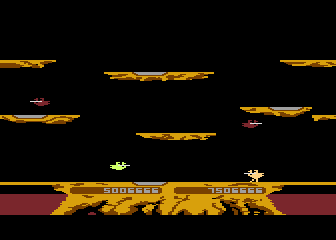 Joust, on the other hand, is one of the best arcade games out there, and still popular at Nickelcades. You play as a man on a flying bird with a lance, and your object is to bop the other birds on the head, killing the man and letting the bird fly off the screen. A certain number of birds spawn each level, and your object is to get rid of them all. The difficulty comes once the levels start progressing: platforms begin disappearing, giant hands come out of the lava to try to grab you (and the other birds: it’s an equal-opportunity lava monster), and sometimes the birds drop eggs when killed that you have to collect before they hatch into more birds. In addition, each wave has a slightly different goal: a survival wave, where you get bonus points for not dying; an egg wave, where you have to grab a bunch of eggs before they start hatching, and the dreaded Pterry wave, where a pterodactyl comes along that is nearly impossible to kill (you have to bop him right on the nose with your lance).
Joust is a lot of fun on one-player mode, but where the game really shines is in its multi-player mode. A second Jouster comes on the scene, and you can either work together to rid the world of the little red jousters, or just concentrate on killing each other. In fact, there are certain waves designed for both: a gladiator wave where you get bonus points for killing each other, and a team wave where you get bonus points for not killing each other.
This game is a game that, similar to Mario Bros. but even moreso, shines in its simplicity. While the gameplay might seem like it gets repetitive, somehow it never really seems so, as the flight patterns of the birds, as well as the different configurations of the platforms each level, always propel you to the next one, just to see what kind platform will go next, or if it’s a Pterry wave, or if it’s finally a gladiator wave so you can justify killing off Player 2. Add to that some corny medieval elements (such as the game stating “Thy game is over” when you lose) and you’ve got a winner in the form of Joust. But you don’t have to take my word for it!
Rating: A-
Kaboom!
 A game that takes a deep look at market research, what makes a deep, engrossing storyline and a multifaceted gaming experience, and then tosses it all out the window in favor of “Guys like stuff that blows up!” Kaboom! stars you, three pad-things that move in parallel motion on the bottom of the screen. Your mission: catch all the bombs that the poker dealer/Hamburglar tosses at you in an erratic and increasingly rapid fashion. If you miss one, all of them on the screen explode, the Hamburglar gets a smirk on his face like “Finally! I just blew up this city! Now for a quarter pounder!” and you lose one of your pads. Once you’ve lost all three, the game is over.
Kaboom! doesn’t offer a ton in the way of variety (you can play with a joystick or a paddle, and you can either have narrow or wide pads), but for some reason it’s infectiously fun. Every time you catch a bomb it plays the next note of the 1812 Overture, which goes pretty dang fast in the later levels. Also, if you catch enough bombs, the villain gets this shocked look on his face like he expected a McRib sandwich and ended up with a Whopper. In addition, there is a two-player mode where the players can alternatively control the burglar and the pads which is a lot of fun.
Kaboom! makes no pretenses: it’s a simple hand-eye reflex game, but it’s a good, colorful, fun one, and I recommend it for anyone who just wants to turn off their brain for a moment and play the 1812 Overture.
Rating: B-
Popeye
 Ahh, licensing. The creation of many a game, good or bad, came from a licensing deal. In this one, based off Popeye the sailor man, you are Popeye, trying to win your beloved Olive Oyl from the clutches of the big brute Bluto. There are three distinct stages. In the first, shown here, Olive Oyl stands at the top of the screen and tosses love to Popeye, who must catch the hearts and use them to build a house (I guess). In the second Popeye is running around the outside of a building at nighttime, while Olive Oyl tosses down music notes that spell out, I dunno, their love theme, I suppose, although the background music during this scene sounds like the Harry Belafonte song “Matilda” featured in Forever Plaid. The third and final level Popeye the sailor man fins himself on a sailing ship, catching “HELP” letters thrown by Olive Oyl to build a ladder to the crow’s nest where she is sequestered.
Common to all these levels are two things: a hag that tosses cans of something at Popeye on occasion, and, of course, Popeye’s nemesis Bluto, who roams around each level looking to pummel poor Popeye. Also common to each level is a one-use can of spinach, which causes the Popeye theme to play and Bluto to run away from Popeye. If you can catch the guy Popeye pops ‘im one and sends him off the screen for about 10 seconds or so.
Popeye is a pretty fun pseudo-platformer and worth a look. It may, like the cartoon and comic before it, get the kids to eat their spinach, and that, at least, makes it a worthy cause. (Besides, a good spinach vinegarette salad is one of the best things in the world, and if I can beat up guys more easily after eating it, well, why eat anything else?)
Side note: is the buff guy that is Popeye’s nemesis named Bluto or Brutus? I’ve heard both, and I don’t know who to believe!
Rating: B+
Obligatory Remix (needs a SID player to work)
BC’s Quest for Tires
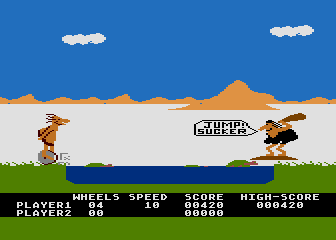 Loosely based on the comic strip B.C., this game stars you as the title character, who is riding on a wheel to rescue your sweetie pie. You’ve got to jump over holes and rocks, duck under tree branches, jump on turtles over lakes while avoiding being hit by some broad with a club (no, really, her official name is “The Fat Broad”), all to end up in a cave inhabited by a dinosaur who kidnapped your girl. You start at a certain speed but can increase it by holding down the trigger and moving the stick (an essential tactic later in the game, when you have to jump over a lake). It’s a colorful, well-designed game, with a parallax-scrolling background, fun sound effects, and challenging but not frustrating gameplay.
Back when I first played this game I had no idea of the comic strip connection, but it isn’t really necessary to understand the comic strip in order to enjoy the game. Our version, however, had some sort of weird graphic glitch (that you can see on the edge of B.C.’s wheel in the screenshot), so instead of getting sad and falling over whenever he hit a tree or rock of whatever, his head just plain exploded into a mess of glitchness. I’m sure that Johnny Hart’s head did something similar when he first saw this game. Another fun fact: this game was designed by Sierra On-Line, a company that would soon go on to define the adventure game genre with classics like King’s Quest and Space Quest.
Rating: B
That’ll do it for disk 6. Coming up next will be disk 7, featuring Starbowl Football, Pole Position, Pitstop, Speedway Blast, Reversi, and Super Cobra. Catch you next time!
Disk 5
Since there’s only one game on side 1, I am combining both sides into one post.
Picnic Paranoia
 It’s Picnic Paranoia! And the bugs are after your food! You play as “George,” a diminutive picnic guard with a flyswatter that’s about half as big as the bugs you are swatting. Your job is to keep the ants away from your food, but oddly enough, you can’t walk on your own picnic blanket/tables (the yellow area in the screenshot), so once an ant gets on the yellow it’s out of reach for poor George. Once enough ants get behind a piece of food they start dragging it away. Fortunately, once they get off the table/blanket you can swat ’em again and push the food back onto the table. Good luck with that, though, for as the levels go on, the ants get faster and more numerous. In addition, jumping spiders create webs you’ve gotta swat through, and every so often, a wasp appears that is bigger than you that can sting you and leave you out of the action for a few crucial seconds.
Picnic Paranoia is a fun little game. The graphics are decent, although it’s just one screen, and the sounds are suitably annoying for bugs (especially the wasp). There’s also a “night” mode, where you can’t see the ground or the yellow tables/cloths, but for some reason can still see the bugs (must be those bio-luminescent ants). Add to all of this the title screen sequence, featuring the song “Flight of the Bumblebee,” and you’ve got the frenetic recipe for Picnic PARANOIA!!!!!!!! AAAAAAAAAHHHHHHHHH!
Rating: B+
Obligatory accordion performance, uh, remix
Claim Jumper
 Well, howdy, pardners! Y’all’ve moved West lookin’ fer gold in them thar hills, but yer neighbor’s shootin’ from the hip! OK, I’ll stop. Claim Jumper involves two cowboys, fashionably dressed in green and, um, pink, wrasslin’ for money in the Ol’ West. The entire game takes place on one screen, where the two cowpokes race for a piece of gold and take it to the assay office. The assayers then give out a stack of money, which a cowboy can then take back to his bank. The trouble is, obstacles such as cacti, snakes, and blobby-things (tumbleweed?) are blocking the way, and every time a player touches an obstacle that is not his color (or anyone touches a cactus) he gets stunned for a few seconds, at which time the other player can grab the gold or money and skedaddle. The blobs and snakes move around the field pursuing the opposite-color player, but don’t worry: a player can poop out eggs or, um, brown things, to get a snake to change into a blob or vice versa and chase after the opponent.
The best part of this game, though, comes from shooting each other. Each player’s got a gun, which can be used to either shoot a snake or blob (either killing it or turning it into the opposite type), or each other. When a cowpoke gets shot his hat flies off and an ignominious “wah-waaah” plays, after which the player us moved to one of the two “hospitals” in the corners. You can even bank shots off the corners of the hospitals in case your opponent is way ahead of you and heading for his bank. Yee-ha!
Once a player fills up his bank, he gets a new house, not to mention 20,000 points. Since the object of the game is to get to 25,000 points, and you get points for every blob or snake you convert, usually filling up the bank with ten stacks of cash signals the end of the game. Different game options include a “head start” mode, where one or both of the players start with five bills already in the bank, or a “buy bullets” mode, where you get a limited number of bullets and must buy more if you run out. This mode was never popular in our house, as the main point of the game for us was to shoot each other as often as possible.
Claim Jumper is an infectiously fun game, and definitely among my very favorites for the system. It’s a rare Atari game where both the players play at the same time (most early games featured the old “alternating” faux-2-player system). Was this game the precursor to more modern FPS multiplayer modes? Could be, but instead of having to deal with n00bs and l33t-sp33k, you can just grab a real-life friend and duke it out among blobs and pooped-out eggs. And by gum, it’s fun.
Once again, highly recommended, pardners!
Rating: A-
Zaxxon
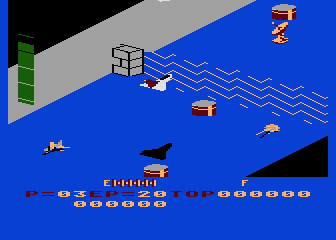 Zaxxon employs the completely unique gameplay of “you’re in a space jet, blowing stuff up that scrolls past.” The difference in this game is that the stuff comes at you in an isometric perspective (apparently the first use of the isometric perspective in video game history). Your mission is to destroy the Zaxxon defense force. This mission consists of three stages. First, you must fly through a fortress-type area, where tanks are shooting at you and there is the ever-present danger of flying into a force-field or wall. Your job is to blow up fuel tanks to somehow refill your fuel before it runs out, and destroy grounded enemy aircraft. The aircraft you don’t destroy comes back in the second stage, apparently with reinforcements, and you must destroy them all to proceed to Zaxxon itself. I don’t know what that part entails, though, since I’ve never gotten past the second stage! That’s right, folks, Zaxxon is a game I never really got good enough at to be able to see the whole thing. You only get three lives, and the collision detection is spotty at best, especially during the second stage, where you can’t really tell where the enemy aircraft are in relation to the ground and they are constantly shooting, with little room and time to maneuver around their shots.
Zaxxon can be fun, and the graphics were certainly groundbreaking, but if you want to be in a plane shooting stuff the concept is better implemented in other games. Or, you could also pick up a copy of Zaxxon for a different system, hoping the graphics aren’t as confusing as they are in the Atari 8-bit version. Either way, good luck!
Rating: D-
Defender
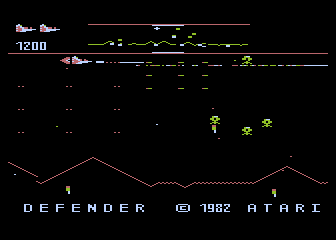 Another in the line of “spaceship/jet shooting stuff that scrolls by” games, Defender has you flying over looping mountainous terrain, defending your homeland (which consists of little flag-things) from abducting aliens. You’ve got a high-tech laser that you use to destroy the invaders, of which there are six types: Landers (small green aliens like in the screenshot that kidnap your flag-people), Mutants (when a Lander reaches the top of the screen with a human and, like in checkers, gets more powerful moves), Bombers (box-things that lay mines everywhere), Pods (slow-moving star-shaped aliens that when blown up transform into Swarmers), Swarmers (pie-shaped aliens that move fast, shoot fast, and come out of Pods), and Baiters (annoying, Evil Otto-type flying saucers that hunt you down if you take too long). When all enemies are destroyed on a level (except Baiters), the wave is complete and you advance to the next, where there are more and faster enemies.
The controls take a bit of getting used to, since whenever you turn around the screen shifts rapidly and you actually end up sliding a fair distance backward, but the gameplay is smooth, the difficulty level is high without being frustrating, and the explosions are fun to see fill up the screen. Plus, if things get too hectic, the player is armed with three “smart bombs” that immediately destroy everything on the screen. Defender is quite a fun shoot-’em-up space game, and I recommend it for anyone just looking to ‘splo some stuff up.
Rating: B-
Missile Command
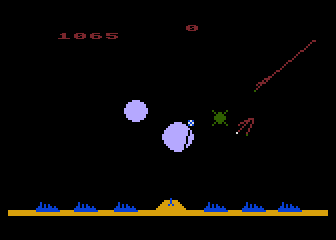 Ah, another classic. In Missile Command you play as the defender (hmm. . .a trend is developing. . .)of six cities under constant missile threats. The missiles streak down the screen as flashing dots, occasionally splitting, MIRV style, into several missiles, as they streak inevitably toward the populace. The only deterrent is your anti-missile battery, which can fire missiles to stop their missiles from missiling the cities. Some missiles are dropped by flying aircraft or UFOs (worth bonus points if destroyed), and some are “smart bomb” missiles that can change direction to avoid your missiles.
If you’re looking for a game with a higher concentration of the word “missile” in its description, you’d be hard pressed to find one (eleven in the previous paragraph). The gameplay was more than just point ‘n click, since due to the delay of your missiles firing your timing had to be just in front of any missile paths to successfully destroy one. Also, you had limited ammo, and once you ran out (or the missile battery itself got blown up), you could only watch helplessly as the enemy missiles obliterated your thriving metropolises. Did I mention that, after every level, it sped up until it was running at an inhuman speed?
Missile Command was simple, yet fun, and an enduring game. In fact, it has been ported to an enormous variety of consoles and computers, and, in fact, they’re still doing it (a version is out for the Xbox 360 right now). Give it a “shot,” and save our cities from missile annihilation!
Rating: B
Well, that finally does it for Disk 5. Coming up next: Disk 6, featuring Buck Rogers, Joust, Kaboom, Popeye, and BC’s Quest for Tires. Until then, folks!
Disk 4, Side 1
Disk 4: the Mario disk. Three out of the four games here involved the world’s most famous video game character (besides Pacman, possibly).
Donkey Kong
 The debut of both Donkey Kong himself and Jumpman, later renamed Mario, Donkey Kong was, and is, an arcade classic. You play as Mario, working as a construction worker in the days before you went into the plumber business with your brother Luigi and got sucked down a toilet to the Mushroom Kingdom. Here you’re just in boring old Brooklyn, where escaped ape Donkey Kong has kidnapped your girlfriend, Laura Ingalls Wilder (named Pauline in the game, but come on; look at that dress!) Your mission is to dodge barrels, peeved-looking fires, jumpy pogo-weights, and other random obstacles to win back your pioneer girl and give that ape what-for! Hammers help you crush the barrels and obstacles flying around, but unfortunately you can’t climb ladders with a hammer, so the game mainly consists of running and jumping. In the final level you undo rivets under Donkey Kong’s platform, which flips him upside-down and sends him flying to an ignominious end 100m below. The “bump” sound made as he hits the ground is less of a bone-breaking splat and more of a “I just hit my head on the doorframe!” whump!, which, actually, sounds more painful.
The Atari 8-bit version is known not only for giving Mario blue hair and a pointy nose, making him look vaguely like a moustachioed witch, but being the only home version of the game that included all four levels found in the arcade version! That’s right, in addition to the barrel-throwing, pogo-weight-jumping, and rivet-removing levels, you can also play the “pie factory” level, omitted from other home gaming systems that licensed the game. I read somewhere that they’re actually supposed to be cement containers, but man, do they look like pies. Deadly, deadly pies.
Donkey Kong was, of course, a ground-breaker in many ways: one of the first platformer games as well as the introduction game of two beloved characters (Pauline was presumably omitted from later games due to her inability to float, pull up turnips, and command entire legions of loyal fungi). But how does it stack up today? It acquits itself admirably, in fact. The easiest difficulty is easy enough for casual gamers to try it, but the later levels (as speed increases) are enough to challenge a hard-core player. In fact, thanks to Haley’s helpful comment on the previous post, I have been made aware of a movie based around getting a high score on Donkey Kong, called The King of Kong.
If you’ve never tried Donkey Kong, give it a shot, if for no other reason than to smash giant barrels with a hammer. I think we’ve all had days where we’ve wanted to do that.
Rating: A-
Donkey Kong Junior
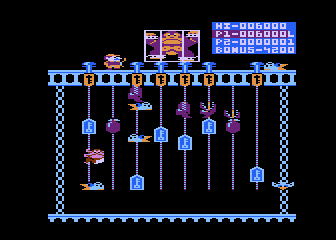 Mario’s back, and this time, he’s violating the laws of PETA. After Donkey Kong failed to keep his damsel in the last game, Mario (strangely dressed in Wario’s color scheme here) locked the poor guy up, chaining his arms and legs so he was no longer able to hide his man-boobs. You play as Donkey Kong Jr., the giant primate’s cute lil’ son, trying to free your father from his imprisonment. Unfortunately, somehow Mario acquired the ability to command alligators and giant blue birds, and as we all know, a monkey-child’s arch-nemesis is the dreaded giant blue bird. Eventually you must unlock all the keys to Donkey Kong’s cage, which allows Donkey Kong to escape and kick Mario’s behind, sending him flying off-screen to presumably conk his head on a doorframe.
Donkey Kong Jr. employs the same kind of technique as the previous game: get to the top of the screen just so your nemesis can whisk his captive off to the next level. In this game, however, there’s more focus on climbing up and sliding down poles and avoiding animals. While Junior can’t really jump worth beans (as you may find out on the second level, where he’s required to jump across some sort of stump-looking things literally inches apart and still regularly miss), his climbing skills are unparalleled, especially with two hands on two poles, which looks uncomfortable but seems to work for him. The game’s jump, climb ‘n dodge approach is just as fun as the original, so I would recommend this game for anybody who liked the first one. Of course, the game might’ve ended differently had Pauline been in it, pleading with Mario to let Donkey Kong go, and then staring into his eyes for hours on end while Mario got eaten by dinosaurs and giant grubs, eventually escaping to form an elementary-school rock band and become a sub-par Mexican wrestler to impress a nun.
Rating: A-
Congo Bongo
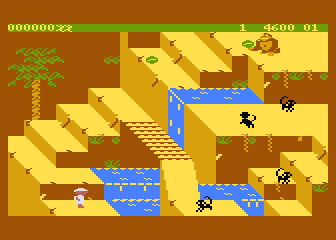 While this is the only game on the disk not to feature Mario, it obviously has similarities to Donkey Kong. You play as some red guy with a hat, hunting down the ape Bongo. Why? He doesn’t have your girlfriend or anything. According what I can figure out it’s because he enjoys throwing coconuts at you, which look more like watermelons. This version of the game only has two levels. First, you climb up the stairs, avoiding the watermelons, but not the monkeys for some reason (they don’t really do much of anything besides look cute). When you reach the ape, he flees across a river that you have to jump across, using sandbars and fish as stepping stools. If you reach him again he flees back to the mountain and you’ve got to climb up to him again and again, until you finally reach the Ninth Circle of Hell, where Satan himself sits, frozen, ready to hurl a watermelon at you.
Despite having only two screens, Congo Bongo was a pretty fun game. The watermelons were hard to avoid, since they didn’t actually moved, but flashed from one spot to another like they were animated on one of those old LCD hand-held games (like the famous Game & Watch or Tiger Toys games), so you had to learn how they moved. Also, the isometric view was unique for its time and added a bit of a challenge. Plus, Bongo doesn’t have the man-boobs that Donkey Kong seemed to possess, so it’s a little less disturbing that way. Give it a try, but after you’ve beat the second level there’s not much to go back to.
Rating: B
Mario Bros.
 Mario got sick of construction and ape-hunting, so he teamed up with his brother Luigi (played by John Leguizamo) to rid the sewers of turtles, crabs, and flies. This is done by jumping underneath one and flipping it over, then disposing of the flipped-over creature. (The crabs must be hit twice while the flies jump and are harder to hit). Occasionally a fireball flies in from the side of the screen and burns you up, or as it looks like, covers you in mustard. As the levels go on the creatures get more numerous and varied, and later on googly-eyed blocks of ice start freezing the platforms, making it harder to stop moving. Every so often a bonus coin level comes up where you’re supposed to grab all the coins before the time runs out.
Mario Bros. is a pretty fun one-player game, but it’s the two-player mode that really shines. You can either work together to rid the screen of pests, or, more commonly, try to screw each other over and knock each other around and even into enemies. This type of play ended up being so popular that it was incorporated into many later Mario games, most notably Super Mario Bros. 3, Super Mario All-Stars, and all of the Super Mario Advance titles. Mario Bros. also introduced many of the elements that would later be used in Mario’s next NES adventure: Luigi, turtles, pipes, and not looking like a witch anymore. Although, with the command that Mario had over alligators in Donkey Kong, Jr., you’d think he’d have full control over any sewers in Brooklyn.
Rating: B+
That’s it for side 1 of disk 4. Join us next time for the second side, which features Track ‘n Field (or Los Angeles 1984 Games), Cosmic Tunnels, and One on One with Dr. J and Larry Bird. See you then!
Disk 3
The second side of disk 3 had orange juice spilled on it early on. Fortunately, my dad was able to transfer most of the games on that side to disk 16, so I’ll get to those games at that point. In any case, here are the games from the first side.
Pacman
 Ah, Pacman. Possibly the world’s most famous video character ever (although that may now be Mario). Born from a Japanese programmer who was eating pizza and got struck with inspiration. In case you don’t know for some reason, the point of Pacman was to eat all the dots in the maze, avoiding the ghosts along the way. There were some larger “power pellet” dots that temporarily turned the ghosts blue, allowing you to chase them for a short time. There also occasionally appeared some sort of fruit, which was worth extra points. That’s it. The maze never changed, the object never changed; the fruit would change and the ghosts’d get faster. That’s about it. Yet it became one of the most popular games of its generation. Mainly because it was the first real non-space-based arcade game. Maybe because, in its simplicity, the game is still fun to play and requires quick reflexes to master. In any case, it’s Pacman.
Here’s a trivia note: did you know the ghosts all had names? And that one of those names was “Clyde?” You may never look at this game the same way again, knowing that Clyde could get you. Ah, Clyde.
Rating: C+ (there are better versions of this game out there)
King Tut’s Tomb
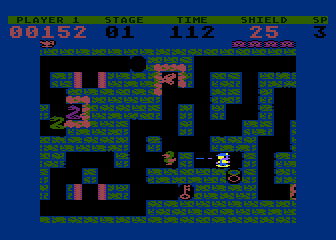 King Tut’s Tomb got corrupted on our disk, so I hadn’t played it until I got it on an emulator recently. The goal was to sneak through King Tut’s tomb, stealing his treasure while avoiding the dangerous creatures along the way. Shooting undead cobras kills them, apparently. Along the way you needed to pick up keys to open the keyholes blocking your way, eventually culminating in the GIANT DOOR at the end, which contained a big lamp. Unique to this game was the ability to customize your controls a bit, and the shield factor: instead of instantly dying when you were touched, the denizens of the tomb drained your shield until you reached 0, at which point you’d become a cute lil’ skull and crossbones.
King Tut’s Tomb was mostly a shoot-em-up in a maze. It was pretty fun, but nothing outstanding. Give it a try, if you’re bored.
Rating: C
Centipede
 So disk 3 apparently had a lot of the more famous early video games on it, and Centipede definitely falls into that category. You were a little gun-type apparatus trying to rid your mushroom field from bugs, including a spider that’d jump around and some sort of slug, maybe(?) (it looked like a fairy) that’d turn your mushrooms different colors. The main pest, however, was the eponymous centipede, who would slowly wriggle its way toward your end of the field. Shooting a section of the centipede would split it into two different ‘pedes, who would then both invade your space by different paths. Completely destroying a centipede would get you to the next level, where everything changed colors and went faster.
This game was another one of those early reflex-dependent games with little else going for it. There was no music, and the sounds were just of your gun firing and the centipede moving around. Still, its simplicity can make it a good coffee-break game, and there are dozens of versions available for all platforms, so grab one and rid your mushroom farm of pests in style!
Rating: B-
Ms. Pacman
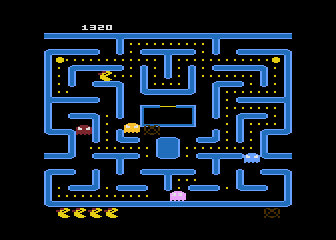 Trying to entice members of the female gender into playing video games, the Pacman guys came up with this little gem. The object is the same: eat dots and fruit, ghosts chase you, etc. etc. The differences, however, made up for the shortcomings of the first game: there were several different mazes, the ghosts behaved slightly more intelligently, the fruit (or other object—you can make out a pretzel in the screenshot) moved about the screen, and, of course, Ms. Pacman herself had an eye and a cute lil’ bow. In addition, every few levels you’d have a little intermission portraying the budding romance between Pacman and Ms. Pacman. My favorite was always the chase scene, although the stork scene is an interesting one as well. Since it improves on its predecessor, I’d say play this one over the original, although I’m not personally a giant fan of either. Sadly, Clyde has been replaced with “Sue,” which isn’t nearly as cool.
Rating: B+
Berzerk
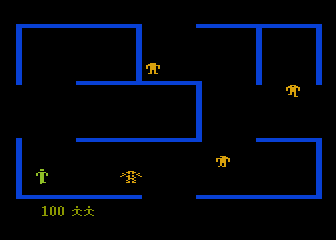 Yet another classic, this game takes place in an electrified maze. Your object was to kill all the robots in a room, and then hightail it out of there before a smiley face known as “Evil Otto” strolled along and zapped you. Rinse and repeat. Otto would also yell at you whenever he’d come after you or you left a room (calling you a coward if you left before killing all the robots) using digitized speech, ooooooooh!. Although basically another shoot-‘n-run game, Berzerk became notorious for actually killing people playing it. So to those who would like to be chased down by a sadistic smiley face in a world where even touching the walls kills you, I say, enjoy Berzerk. . .but take your heart medication first, and make sure you are not pregnant, elderly, or injured in any way. Good luck!
Rating: B-
Crossfire
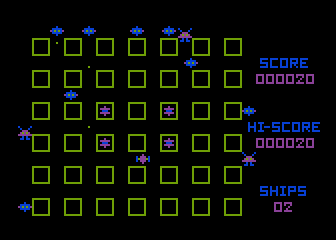 Hey, it’s a not-classic game! In Crossfire you were shooting at little aliens who resembled Chinese lanterns on a grid. The trick was, the aliens were coming from all sides, hence you were caught in the “crossfire.” Occasionally a spiky thing would pop out of the middle boxes and you could grab one for extra points. When you killed a Chinese lantern it’d come back as a different-shaped alien, and when you finally rid the grid of all offending attackers, you’d move to the next level, where—you guessed it—the aliens would move and shoot faster. What is it about these old games anyway? I mean, come on, you can do more with 64k of memory than that! Crossfire can be fun for a bit, but in the end it’s just another shooter, and there are plenty of other superior shooters out there. I’d say pass this one up.
Rating: D
Fast Eddie
 Fast Eddie was an interesting, colorful game. You were the title character, a fat, hatted man with apparently only one leg, and you were stuck in a platform/ladder-style board. Strange blue creatures of different styles ran around underfoot, and glowing objects (such as the fish(?) in this screenshot) floated above your head. On the top level one of these creatures, colored brown, had exceptionally long legs and could not be jumped over. The object was to collect ten of the glowing objects, each of which would shorten the legs of the guy at the top. When it was as short as the other creatures, a key would appear above its head, which you then needed to grab to make it to the next level, where the objects would change and you’d do it over again. Each time you cycled through the different object types the layout of the ladders and blue creatures would change: on a certain floor there might now be two creatures or three running around, or one big fat one, or some combination. It was these combinations that gave this game replay value aside from “get the high score” and, as a run’n’jump game goes, this one was fairly fun. I’d say give it a shot, even if it was just to see what silly objects you had to collect.
Fish? Really?
Rating: B-
Obligatory remix(well, not really, but still!)
I’ve done three of these reviews within 24 hours, and I think I’m going to take a break before launching into disk 4, which is the first disk so far where both sides worked. So stay tuned for Donkey Kong, Donkey Kong, Jr., Congo Bongo, and Mario Brothers!
Disk 2
Side 1 of Disk 2 contained a program that I have yet to find, as the disk got corrupted when I was very little. All I remember is that it was some sort of drawing program that I really really loved. Oh, well. Side 2 contained two of my top Atari games of all time, so it was one of the most-used disks we owned.
Necromancer
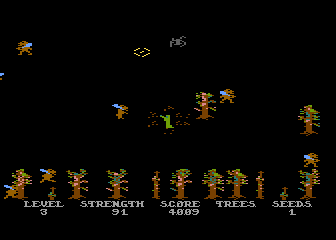 Necromancer was one of my favorites on the Atari. You were a little druid/wizard who was battling an evil necromancer and his army of creepy spiders. During the first stage you were protected by a force field that looked vaguely like the Star of David and you used a little magic wisp to grow seedlings. These seedlings were threatened by walking dwarf-type people that looked like they either had wings or those lampshade things they put on dogs who had surgery so they won’t chew on their casts. Eventually the seedlings would grow into full trees, which were then immune from the dwarves but could be torn down by a giant spider that occasionally flew around and, um, made the trees scream.
In any case, the first stage ended when your strength ran out and you went to the second stage with however many trees you grew. This stage was even odder: you were in some sort of stone structure with giant hands coming out of the ceiling and rows of chambers containing spider eggs. Your goal was to get through the chamber unscathed by growing ladders using magic ? marks the hands left behind, while at the same time using your army of grown trees to crush the spider eggs. The catch was sometimes an egg would hatch and a spider would fly out, trying to steal your trees and weaken you. This happened for five screens (in each one the hands and spiders would get faster), which led to the final stage: the showdown against the necromancer himself.
The evil wizard would pop up behind gravestones, leaving trails of spiders in his wake (the more eggs you crushed in the previous stage, the less spiders there’d be) who would drain your energy if they touched you. You could clear away the spiders with your wisp, but sometimes his pet giant spider would come along. If it touched any normal spider, the normal spider would start to glow and become impossible to kill: you just had to avoid those ones. Your object was to pick up all the gravestones on the screen so the necromancer couldn’t use them to reincarnate himself. This, supposedly, went on for five screens, after which you win the game. I say supposedly because I have never beaten this game! Yes, despite having this game since before I could remember, I have never beaten the final stage. Even today, when I’ve gotten much better at games in general and have save-states and emulators to help me out, I’ve still never seen the end of this game. There are just too many spiders in those last stages, even if you get rid of every single spider egg in the previous ones! A lot of the earlier stages depend on luck anyway: in the first stage the trees can either shoot up like weeds or take literally five whole minutes to bloom, or anything in between. The same is true for the trees breaking through the spider egg compartments. And if a spider hatches in a compartment with a tree above it, say goodbye to that tree and hello to another spider in the final round. Bagh!
This intense difficulty notwithstanding, the game rarely gets frustrating. Part of that is the first round: you can either grow 30 trees or none at all, but you still can “beat” the first round. In fact, it’s technically possible to win the game without any trees, if you can contend with the literal army of spiders during the final round that will make it virtually impossible to move. The graphics are also colorful and fun, but what really made the game for me was the music. During the game there was this demented, jazzy bassline playing, which would add sevenths and thirteenths whenever the giant spider appeared. But the best music was over the title screen: a haunting melody that would slowly get louder and add a 4-part countermelody. All in all, Necromancer was a top-notch game, however illogical and demented it was, and I highly recommend it.
Rating: A
The Last Starfighter
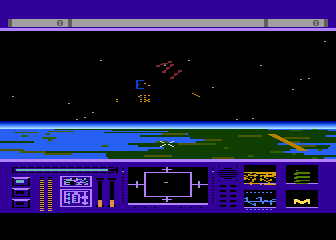 The Last Starfighter was actually apparently a beta version of Star Raiders II. This version was based on the movie of the same name, which I’ve actually never seen but have been told the plot by my brother-in-law: how a kid plays this video game and gets the high score, and is then whisked into space by some actual aliens (headed by Professor Harold Hill, apparently) to save their planet based on his l33t skillz.
In the game itself you must defend a solar system from the evil invaders, who are sending out red-colored short-range fighters (seen in the screenshot here) from their mother ships, which are supposed to be flying saucers but look more like cymbals with eyes. If you stave off enough attacks from the cymbals you can warp to their system, where you are supposed to destroy all their cities on their planets to, um, get revenge, I guess, although it seems that saving your planet from being wiped out by wiping out hundreds of civilian cities of the enemy would be a bit harsh. In any case, the graphics are pretty good for the time (the pseudo-3D when you are fighting the short-range fighters and flying over planets is especially worth a mention), and the gameplay is pretty fun, although a bit repetitive when you have to deal with the same horde of fighters and cymbals time and time again. Also, since you can fly to a star at any point to recharge your energy, it doesn’t matter how much damage you take in a fight: the fight resumes where you left off when you return. (Although, spending too much time at a star can be kind of fun and frightening at the same time: the heat literally melts your ship off the screen, and the effect is a bit jarring.)
Anyway, this game is a bit of fun, and you can either play it here in its beta stage or grab it, fully completed and with all the movie references removed, as Star Raiders II.
Rating: A-
Pitfall II
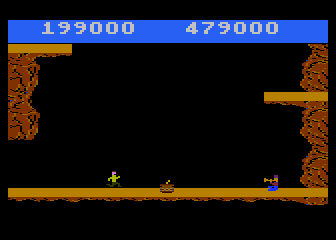 Pitfall II, bar none, was my favorite game for the Atari 8-bit computer, and in fact is still in my top ten favorite games of all-time. You are Pitfall Harry, an adventurer who has lost his niece Rhonda, the beautiful Raj diamond, and some sort of cat-creature that looks nothing like a cat named Quickclaw. You must traverse the dangerous Lost Caverns to find them, grabbing gold bars and dodging bats, vultures, scorpions, and electric eels along the way. Pitfall II was unique at the time in that it had an open world to explore, and that the game would actually end instead of just starting over and getting harder (in fact, there was a blog by Strong Bad about this very subject not too long ago).
The best part, though, was that the version available for the Atari 8-bit computers and the Atari 5200 had an easter egg: after finding the girl, ring, and cat-thing, you were transported to an entirely new level, which was both much more interesting and difficult than the original. Now you had to deal with giant ants, crazy bats, pirahnas, and more intelligent frogs, along with devious jumping puzzles. Your quest now was to find a snake-charmer person, a bowl, a horn, and the Golden Rope (which was Pitfall Harry’s only hope) in order to escape the Lost Caverns and see daylight once more. The level was fairly difficult by itself: fortunately, you couldn’t die. Each time you touched a vulture or ant or whatever you lost some points and were sent back to the last red cross you touched, which were scattered about the levels. Unfortunately, there were some very difficult areas (like the path to the Golden Rope itself) without a red cross in the middle, adding to the challenge. Also, getting a perfect score took a lot of effort, as not only could you not touch any creatures, but even the act of falling to the next floor below often cost you 100 points, leading to a lot of convoluted routes to pick up all of the gold. This, of course, added to the replay value, which was needed in a game with a finite ending.
Pitfall II was not just a pioneer in the gaming field, it was also very fun. The game was kept interesting also by the music: a sprightly heroic theme would play every time Harry picked up some gold or other treasure, and a sad version of the theme would play every time he touched a creature. The rest of the time, a “moderate” version of the theme would loop, which may get tiring after a while, but for me only added to the impetus to find the next piece of gold and hear that heroic tune again! You can find all three themes here.
In any case, if you love exploration games, swashbuckling jungle tales, and games that are fairly easy to beat but difficult to master, grab Pitfall II for the Atari 800 or 5200!
Just for fun, here is a video I uploaded of the end of the game when I got a perfect score (a feat in and of itself):
Rating: A+
Frogger 2
 Finally we come to Frogger 2, the sequel to the very famous and popular Frogger. You once again took on the role of the famous frog, trying to get across obstacles to plant your froggy face in the top of the level. This time around, instead of crossing roads and streams, you began underwater and had to avoid fish and sharks. There were three logs that could hold your face at the top; however, if you jumped on the top of the logs, you would find yourself on top on a different part of the level, where you jumped across lilypads, ducks, hippos, and alligators to plant your face in a life preserver at the top. If that weren’t enough, you could also take a ride on a mother duck and find yourself in the sky, where you had to bounce on clouds and birds and avoid a giant dragon to immortalize your face in the heavens, so that every time a schoolchild lay on his/her back and pointed out shapes in the clouds, he or she would say, every time, “Hey, that one looks like a frog! In fact, it looks just like that frog caught in the life preserver over there!”
Frogger 2 was a pretty fun game, especially if you were a fan of the original but wanted more variety. The sound was nothing to write home about, but the graphics were pretty good for the eight-bit era, and the gameplay was varied enough to keep you coming back for a little while, at least. All in all, a good game, though not one of my favorites.
Rating: B+
Well, that’s it for this edition. Stay tuned for disk 3, which contains the fun games Ms. Pacman, King Tut, Centipede, Pacman, Berzerk, Crossfire, and Fast Eddie. Until then, keep on retro-gaming!
Disk 1
Professor IQ
 Ah, Professor IQ. The game that professed to be educational when really. . .OK, it was obviously educational and not much else. Two players would take turns spinning the “Wizard Wheel” and then play a mini-game. In Puzzle Time there was a sliding-tile puzzle of the alphabet that had to be put in the correct order. Word Scrambles showed a mixed-up word that you had to put in the correct order. Math Fun simply gave you a math problem you had to solve. Finally, Reverse it showed a line of numbers, starting with just 0-2 and eventually going from 0-9. When you pressed the joystick trigger the line reversed itself from the cursor to the left side. The object was to order the numbers correctly from 0 to 9. While all of these games sound about as exciting as scraping your gums, the point was to earn credits, which were then spent on a somewhat amusing final mini-game where you and your opponent (or the computer) had their icons placed on an 8×8 grid. You could spend each credit filling in a square of the grid with your color (overwriting the other player’s color if it was already there). The game was won when one person had filled in the entire grid with their color. You could also “eat” your opponent and send his icon outside the grid if you had more credits than he.
Professor IQ was about as fun as it sounds. However, the bright graphics and cheery music kept it from being a total snore-fest, and if you like those sliding-tile puzzles you might enjoy the alphabet game. Also, in the math and word scramble games a snake-like character with a graduation cap marched across the top of the screen, and if you took too much time solving the problem, an unseen assailant would throw a book at it and a giant “WRONG!!!” would appear at the top. This was obviously in the days before political correctness would take effect; nowadays an authority figure would put an arm around the snake and a giant “YOU ALMOST GOT IT!! KEEP TRYING!!” would appear.
Rating: C-
Well, that’s the only game on Disk 1. Next time: Disk 2, consisting of Necromancer, The Last Starfighter, Pitfall II, and Frogger 2.

 Atarieviewer